
Manufacturers of rubber, precision injection molded and die-cast components have long been plagued by flash and burr issues. Manual trimming suffers from low efficiency and inconsistent quality. Tiny burrs hidden in inner cavities and blind holes are hard to remove, while rising labor costs hinder mass order fulfillment. STMC independently developed the liquid nitrogen cryogenic deflashing machine. Based on the low-temperature embrittlement principle, it delivers a surge in efficiency and a sharp cut in costs, providing automated deburring solutions for automotive parts, medical devices, new energy, 3C electronics and other industries.
Traditional manual deflashing requires piece-by-piece trimming. It is time-consuming, and inconsistent workmanship may scratch workpieces and generate defective products. Complex profiled parts and burrs in narrow gaps are especially difficult to handle, requiring large workshop space for semi-finished goods. STMC cryogenic deflashing equipment uses liquid nitrogen as refrigerant to rapidly cool and embrittle the flash of workpieces. High-speed media blast strips the burrs away, while the workpiece base remains tough and free from damage for non-destructive precision deburring.
Surge in Efficiency: Automated Batch Processing, Multi-fold Capacity Growth
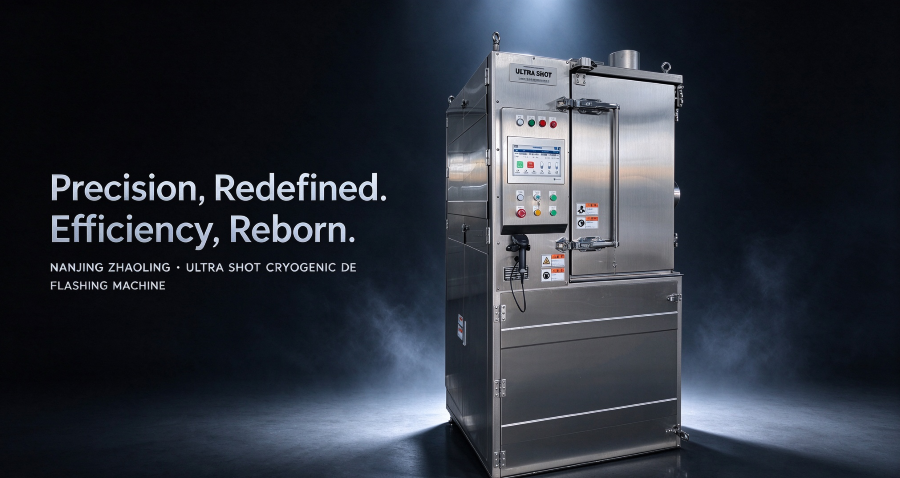
STMC ultra-shot series cryogenic deflashing machines support batch processing in baskets. One batch can be finished in around ten minutes. A single machine can replace 6–12 skilled trimming workers. One operator can manage 2–3 units simultaneously to save labor. Hidden burrs in cavities, gaps and blind holes are removed in one pass, eliminating secondary manual touch-up. The overall post-processing capacity rises 3–5 times. The machine occupies only about 2 square meters, reducing space taken by manual trimming lines. Factories can take on larger-volume export and automotive orders without plant expansion. Equipped with a PLC intelligent control system, it stores multiple product process recipes for one-click changeover, stable and suitable for mixed production of various parts in large batches.
Slash in Costs: Cut Labor and Lower Overall Manufacturing Expenses
Labor, staff management and rework scrap are the biggest costs of manual deflashing. After adopting STMC liquid nitrogen deburring machines, labor costs can drop by more than 70%, relieving pressure of recruitment, training and management for repetitive trimming positions. Standardized low-temperature processes deliver consistent deflashing results and greatly reduce scratches and rejects caused by human error. Although there is upfront equipment investment, the unit processing cost keeps falling with volume, with a short payback period. This purely physical process produces no chemical waste and meets environmental regulations, removing hazardous waste disposal costs and bringing real cost benefits to production lines.
The equipment works well for rubber (silicone, FKM, EPDM, etc.), TPU/TPS elastomers, various engineering plastic injection parts, zinc/magnesium/aluminum alloy die castings. It covers O-rings, oil seals, precision electronic connectors, small medical components, new energy rubber and plastic accessories to meet micron-level precision deburring requirements.
STMC is a national high-tech enterprise and Jiangsu specialized, sophisticated, unique and innovative SME. With more than ten years of expertise in cryogenic deflashing, it holds a number of patented technologies. STMC integrates R&D, manufacturing, process testing and after-sales services. Custom solutions are available according to product size, material and burr conditions, together with blasting media supply and process optimization support. STMC helps manufacturers automate deburring operations, break the bottleneck of manual trimming and achieve quality improvement, efficiency gain and cost reduction.
Post time: Oct-21-2026


