
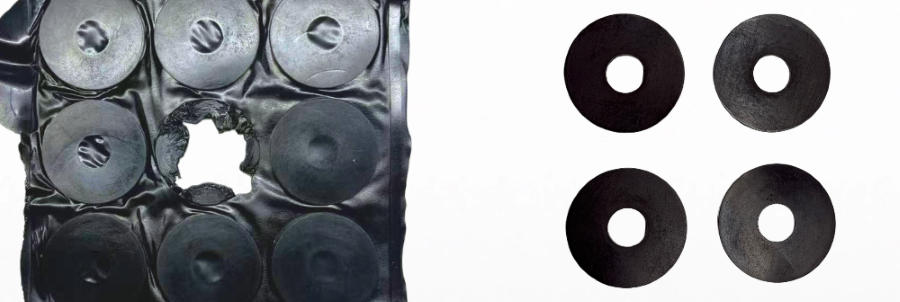
Recently, Nanjing STMC Precision (STMC) presented a set of before-and-after comparison samples of chloroprene rubber (CR) washers finished through cryogenic deflashing in the field of rubber and plastic parts post-processing. Untreated parts remain attached to a thin web with visible flash and excess molding residue, while after deflashing, the finished washers appear regular in outline, clean in bore, and smooth on the surface—offering a practical reference for batch finishing of rubber seals and dampening components.
1. Parts on Trial: A Versatile Weather- and Oil-Resistant Elastomer
The comparison samples are round washers made of chloroprene rubber (CR). With good ozone resistance, aging resistance, oil resistance, and weatherability, CR is widely used in sealing gaskets, cushion washers, and electrical insulation parts. Flash and gate residue left after molding directly affect assembly accuracy and appearance quality.
2. Before-and-After Comparison at a Glance
- Before deflashing: A number of circular rubber parts are still connected to the continuous web; flash and overflowing residue wrap around the edges, with some molding marks remaining on the surface, requiring further cleaning before use.
- After deflashing: The washers are fully separated from the web. Inner and outer edges are smooth and clean, the center holes are well defined, and the parts stand individually in neat order, with no obvious tearing, chipping, or surface scratches.
3. Process Advantages: Clean Flash Removal Without Damaging the Parts
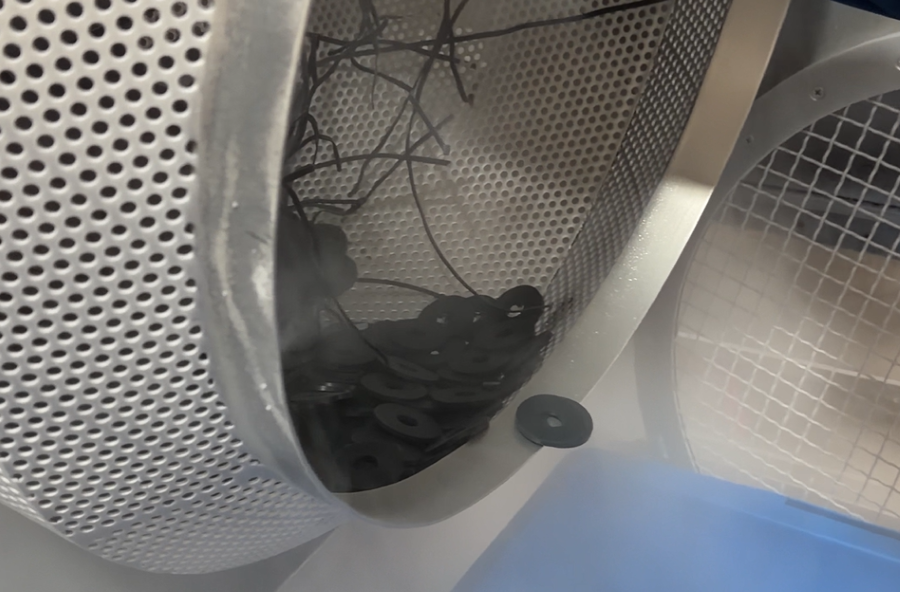
According to STMC, cryogenic deflashing embrittles rubber flash at low temperature, and then removes the flash with freezing media and vibration. The process completes precision finishing while protecting the integrity of the product body. Its main features are as follows:
- Flash-free results: Thin flash around edges and holes is thoroughly removed, delivering cleaner finished parts.
- Non-damaging processing: The working conditions stay within the elastic tolerance range of the parts, preserving dimensions and surface integrity.
- Higher finished quality: Improved appearance consistency helps enhance downstream assembly experience and product competitiveness.
- Stable automated operation: Suitable for continuous batch processing, helping customers reduce manual trimming and achieve cost and efficiency gains.
4. Application Scope and Value
For CR and other rubber or engineering-plastic elastomer parts, cryogenic deflashing can serve as a post-molding finishing step after injection or compression molding. It is suitable for seals, dampening parts, washers, and irregular rubber profiles, helping manufacturers standardize appearance, shorten delivery cycles, and reduce dimensional variation and damage caused by manual trimming.
STMC Precision (STMC) focuses on cryogenic deflashing equipment and process support. It provides flash-removal solutions for parts made of different materials, helping rubber and plastic component manufacturers improve product quality and production efficiency.
For manufacturers looking for automated flash‑removal solutions, STMC welcomes sample process tests. Global business inquiries can reach marketing@stmc.group or visit our official website Contact – Showtop Techno-machine Nanjing Co., Ltd.
Post time: Nov-27-2026


